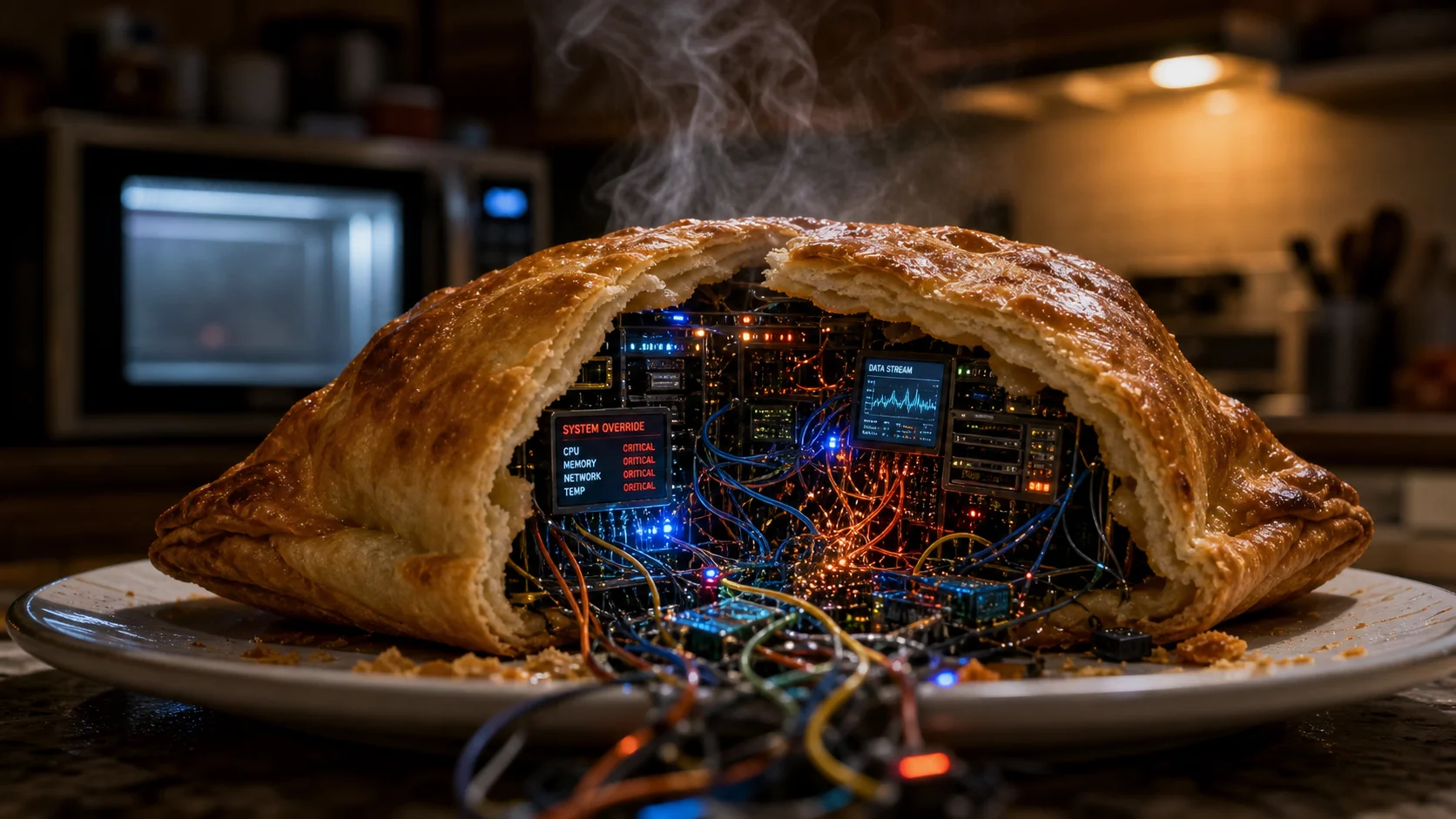
Jim Gaffigan has an entire bit about Hot Pockets. The whole joke is that Hot Pockets are positioned as the perfect food for any occasion — breakfast, lunch, snack, dinner, late-night, picnic — and yet nobody you’ve ever met has voluntarily said, “You know what would really hit right now? A Hot Pocket.” The product promises everything and delivers a microwaved injury.
That’s what most of the popular open-source AI projects feel like in 2026.
I’ve spent over fifteen years reviewing tech architectures from every corner of the business. The questions don’t change. Is it well architected? Is it secure? Reliable? Efficient? Does it optimize for cost and sustainability? Doesn’t matter if it’s a productivity or a product play.
And lately, the answers are uniformly bad.
Monoliths again, really?
Pull up any of the most-starred, highest-contributor projects. openclaw. hermes agent. you know the rest without me saying. Open the README and start counting concerns:
Agent harness. Agents. Sub-agents. Agent communication. Agent registries. Agent activation and lifecycle. Multi-agent orchestration. Routing — between agents, between models, between tools.
A model gateway abstracting OpenAI, Anthropic, local LLMs, and whatever ships next Tuesday. Prompt templates. Response streaming. Response caching.
Skills. Tools. Tool registries. Function-calling shims. MCP servers. Code execution sandboxes. Browser automation. Shell access. File system access. Web search. Plugin systems.
Memory — short-term, long-term, episodic, semantic. Vector stores. Embedding pipelines. Re-rankers. Knowledge graphs.
Storage layers. Conversation persistence. Session checkpointing. State management. Workflow graphs. Plan/replan loops. Reflection and self-critique.
Runtime. CLI. Web UI. Admin dashboard. HTTP API server. Python SDK. JavaScript SDK. Container images. Kubernetes manifests. Multi-tenancy.
That is one repo. That is one release cycle. And inside it: hundreds of pre-built agents nobody asked for, hundreds of skills nobody will ever touch, all bundled and shipped on the same main branch. Hot Pocket architecture. Breakfast, lunch, dinner, agentic memory layer, vector database, dashboard, CLI, and an MCP server — all in the same wrapper, all microwaved together, all advertised as the only food group you’ll ever need. I remember the reason why we moved away from the monolith — am I alone here?
Who’s Staking Their Business?
The pitch makes sense if your goal is GitHub stars. It does not make sense if your goal is a system somebody pays you to run. And the gap between those two goals is wider than the marketing suggests — popularity and production-readiness are not the same software category, no matter how many of us have starred the repo.
So who is actually going to put one of these monoliths into production and stake their business on it? I haven’t met that person. I’ve met a lot of people playing with them. I’ve met zero CTOs who’ve signed an SLA against one and slept well that night.
Am I the Dinosaur?
I fight with myself on this. Am I the dinosaur who doesn’t get it? Is “modular, observable, replaceable” just an old man’s preference now? Maybe. But I’ve watched enough cycles to know that the projects that get into production aren’t the ones that try to be every meal — they’re the ones that do one meal extremely well, and let the rest of the kitchen exist.
I don’t have a powerful closer here. I’m not going to claim I know the future. But in the rush to demonstrate magic — to make sure the next release is the biggest, baddest, most complete thing — I suspect a lot of failure on the horizon. Not only with AI tools but with any complex system that is being developed with AI. Not the spectacular kind. The boring kind. The kind that shows up in a postmortem six months later, where someone has to explain to a board why the production system was a hobby project wearing a tie.
Ask yourself this question the next time you deliver something with AI: did the practices that evolved over the past decades to build modern software expire because we put “AI” in front of them? I think not.